
Baloch nationalists have targetted Gwadar port in the past as they look upon the Chinese-financed port as a gateway to facilitate the exploitation of the gas resources of the province.
"If India has some concerns over the Gwadar port, it may be discussed. However, we cannot stop our progress due to concerns from any quarters," said Admiral Muhammad Afzal Tahir. Last month, Indian Navy chief Admiral Sureesh Mehta had said that the Gwadar port has serious strategic implications for India.
Pakistan and China have signed an agreement in Islamabad to hand over the GwadarPort to a Chinese company.
China's take over of Pakistan's strategic Gwadar port is not aimed at 'encircling' India, but the move is crucial to the country's economic interests as it gives western China access to the Arabian Sea to access oil supplies from the Gulf, official Chinese media said on Friday.
For India, China's Indian Ocean power projection, maritime domain awareness, dual-use ports, underwater surveillance, antisubmarinewarfare, naval exercises with Pakistan, pose considerable pressure, depleted India's strategic depth and marginalises Indian role, points out Srikanth Kondapalli.
Pakistan and China on Monday signed an agreement to hand over control of the strategic Gwadar deep sea port to a Chinese company, with President Asif Ali Zardari saying the move would give new impetus to bilateral relations and economic cooperation.
'China's basic purpose of taking the Shaksgam Valley was access to the Indian Ocean.'

To this end, India has recently committed USD 400 million in steel to construction of the railway connecting Chabahar and Zahedan, near Afghan border, the report said.
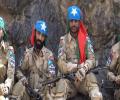
The action, it said, "demonstrates the Trump administration's commitment to countering terrorism".
China's new naval strategy of 'far sea defence' is aimed at giving Beijing the ability to project its power in key oceanic areas, including and most significantly the Indian Ocean. China has fired the first salvo. Others will have to react seriously if they want to retain their role in the region, says Harsh V Pant.

A senior Pakistani minister has admitted that the country failed to capitalize on the China-Pakistan Economic Corridor (CPEC), citing attempts by the previous government to undermine Chinese investments, leading to investor flight.

Today's situation in the Shaksgam Valley is the consequence of what happened in Gilgit in 1947. But is India ready to militarily get back its territories? asks Claude Arpi.
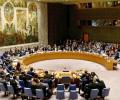
Pakistan and China have submitted a joint bid at the UN Security Council to designate the Balochistan Liberation Army (BLA) and its suicide wing - Majeed Brigade - as a terrorist entity under the Council's 1267 Al Qaeda Sanctions Committee.

'Gwadar has the potential to facilitate PLAN's operations in the Arabian Sea and Indian Ocean.' 'Reports of China setting up electronic eavesdropping posts at Gwadar to monitor US and Indian naval activity and shipping traffic through the Straits of Hormuz and the Arabian Sea lend credence to this,' says former RA&W officer Jayadeva Ranade.
Talking about 'Chinese designs on the Indian Ocean,' Naval cMehta said China had a strategy called `String of Pearls,' as per which it seeks to set up bases and outposts across the globe, strategically located along its energy lines, to monitor and saefeguard energy flows. "Each pearl in the string is a link in a chain of the Chinese maritime presence," he said. "Among other locations, the string moves northwards up to the Gwadar deep sea port on Pakistan's Makran coast.

China has commissioned its third aircraft carrier, the Fujian, featuring advanced electromagnetic catapults, amidst rising tensions and military modernization efforts.

Three terrorists attempted a forced entry into the hotel. A guard at the entrance challenged them after which the terrorists opened fire and killed him, the army's media wing Inter-Services Public Relations said.
The recent Chinese takeover of Pakistan's Gwadar port, bringing Beijing right into the heart of the Indian Ocean and within hand-shaking distance of Delhi, can be explained by a still-evolving strategy called March West by the senior leadership of the Communist Party of China.

New Delhi might have loudly welcomed an age of multipolarity, hedging and strategic autonomy. But it seems the winner in that game is Islamabad, not us, points out Mihir S Sharma.
Having control over both digital media and NGOs, it was easy for the US to topple the government and destabilise Nepal -- to undercut Chinese influence and pressure India, argues Lieutenant General Prakash Katoch (retd).

'No military offensive by Pakistan will end the insurgency in Balochistan without simultaneous, concerted efforts toward political dialogue to de-escalate tensions.'
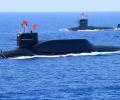
China has delivered a second advanced submarine to Pakistan, part of a larger deal to bolster the South Asian nation's naval capabilities in the Indian Ocean. The move underscores China's growing influence in the region and its strategic partnership with Pakistan.
Pakistan's deputy Prime Minister and Foreign Minister Ishaq Dar, who is in China on a four-day visit, and Chinese Foreign Minister Wang Yi co-chaired the fifth round of the foreign minister-level China-Pakistan Strategic Dialogue.

'The struggle of insurgents and pro-independence political activists is fuelled by a deep conviction that not only is a free Balochistan possible, but they also believe that Pakistan will inevitably break apart, leading to Balochistan's independence.'

This move is seen as part of efforts to strengthen China's ties with Pakistan and safeguard Chinese investments in Pakistan-occupied Kashmir, particularly related to the China-Pakistan Economic Corridor.

Pak PM Imran Khan said the terror strike was an effort to 'sabotage' the country's economic projects

JNPT, the country's largest container port at Navi Mumbai, and Kandla in Gujarat's Kutch, the largest port by total cargo, will come together to form a Special Purpose Vehicle to operate the terminal at Chabahar, under a revenue-share agreement with the Port and Maritime Organisation, Iran.
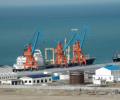
The Pakistani authorities are hoping that the Chinese agreement to take over the operation of the Gwadar port could act as a deterrent to India whom they suspect of helping the Baloch freedom-fighters, notes B Raman.

This has also raised concerns over undetected infiltrations from across the Line of Control and terrorists potentially residing in the outskirts of cities and villages, they said.
The attack took place at around 0940 IST as 12 Chinese engineers were being transported by a coach to Gwadar port, about 500 kilometers west of Karachi, near the border with Iran, Sattar Lasi, the chief of police in Gwadar said.

'The accusation that Pakistan risks losing sovereignty to China is emotive and has the potential to spread.' 'China will, however, remain intent on achieving its strategic ambitions of acquiring Gwadar port and securing a large chunk of Pakistan occupied Kashmir,' says former RA&W officer Jayadeva Ranade.

Access to Sabang Port will allow the Indian Navy to dominate Malacca Strait more effectively, reports Ajai Shukla.

The order was issued a day after Shehbaz held a telephonic conversation with Chinese Premier Li Keqiang and among other issues also discussed the issue of security of Chinese in Pakistan.

'Either China is building regional transport infrastructure long before it needs it, or this is in a chain of Chinese investments with more strategic than economic intent,' says T N Ninan.

A fleet of eight JF-17 Thunder fighter jets -- jointly made by the two countries -- will escort the Chinese president once his plane enters the Pakistani airspace.

The banned Baloch Liberation Army (BLA) claimed responsibility for the attack, saying the blast was a suicide attack targeting a convoy of Chinese engineers and investors leaving the Jinnah International Airport.

India's involvement in the port development was not strictly under the international sanctions that had been imposed on Iran.
Six decades of complaints about 'foreign involvement' in creating unrest in Balochistan has done no good to Pakistan neither have its intermittent military operations in the province. Islamabad has resorted to repressive measures to muzzle the Baloch demand for greater autonomy and right of ownership of its natural resources. This has not worked.

Beijing's political risks are also escalating because of a renewed wave of public anger in many parts of Balochistan against human rights abuses by Pakistani troops deployed to crush the low-intensity insurgency in the province, the report said.
 © 2026 Rediff.com - Advertise with us - Disclaimer - Privacy Policy - Sitemap - Feedback - About us - Terms of use - Grievances